
Ikaruga
Description (IGDB)
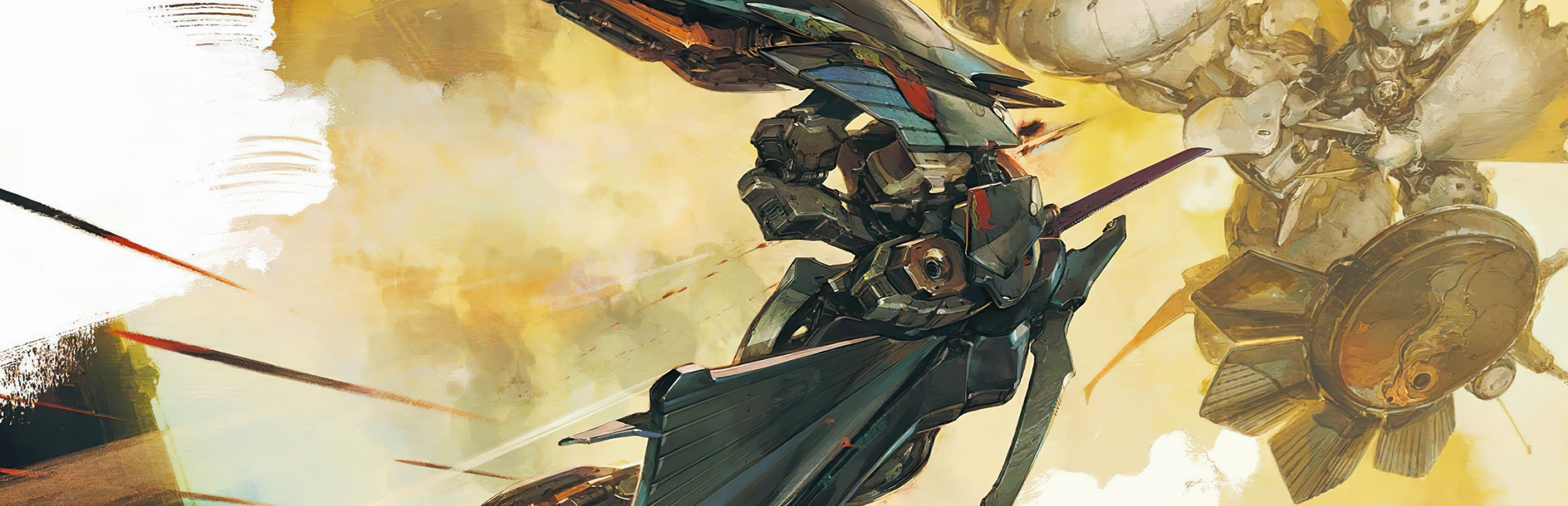
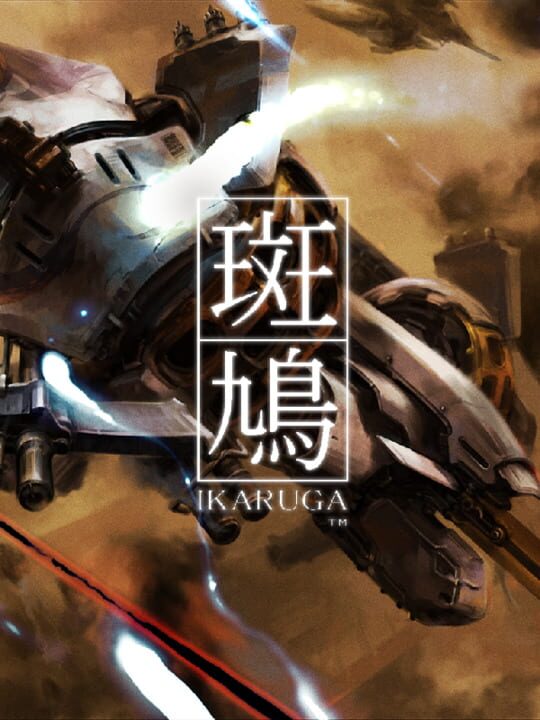
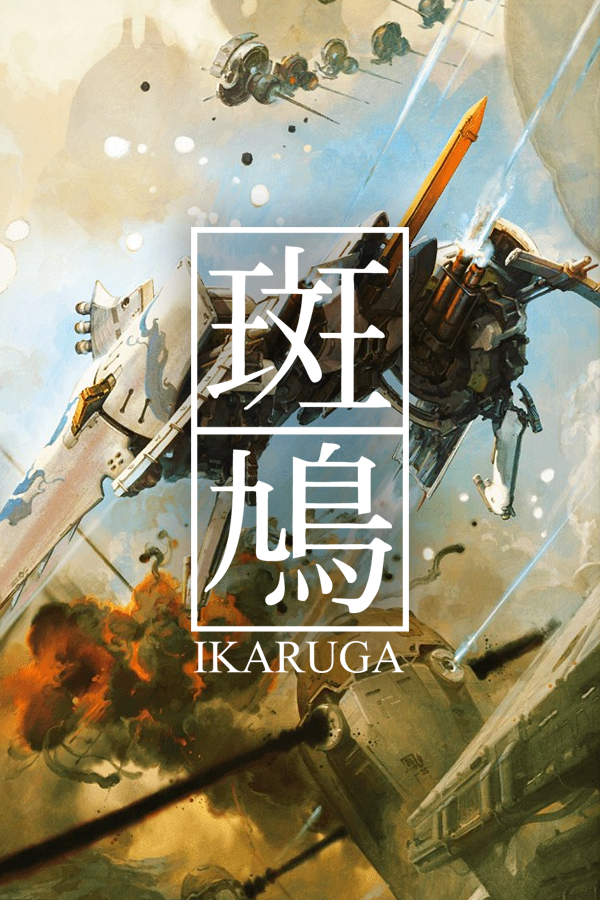
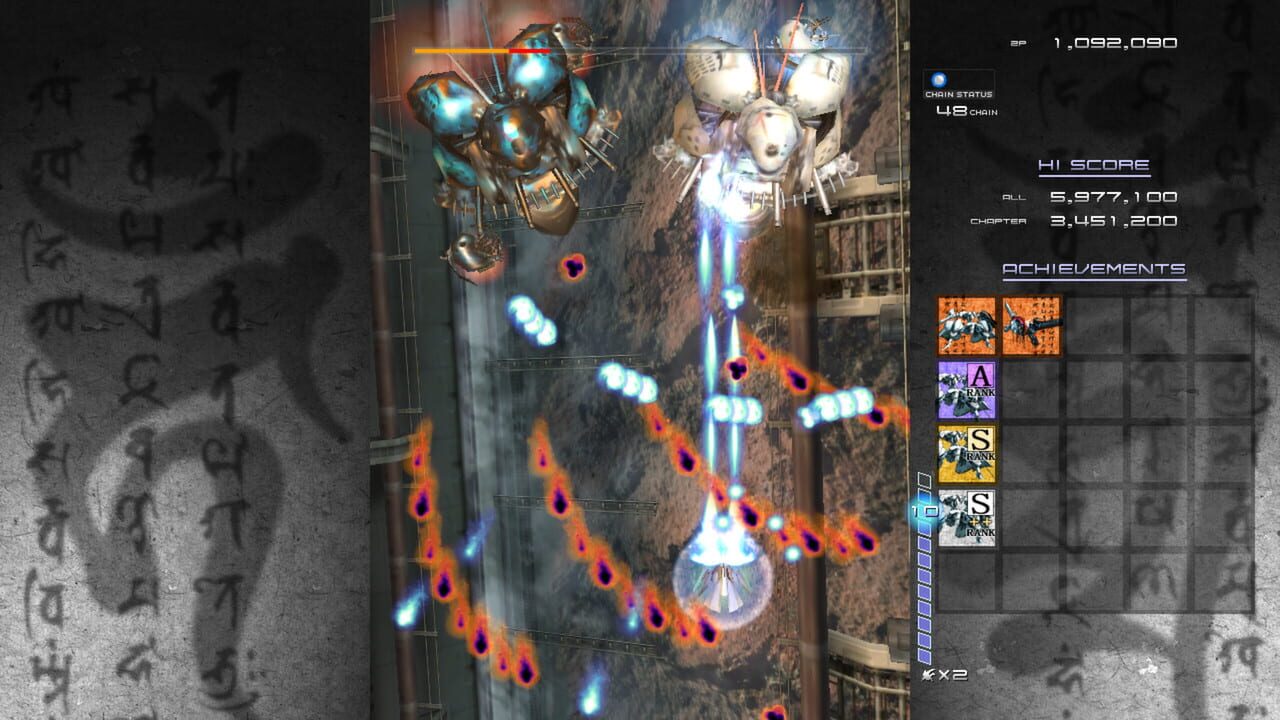
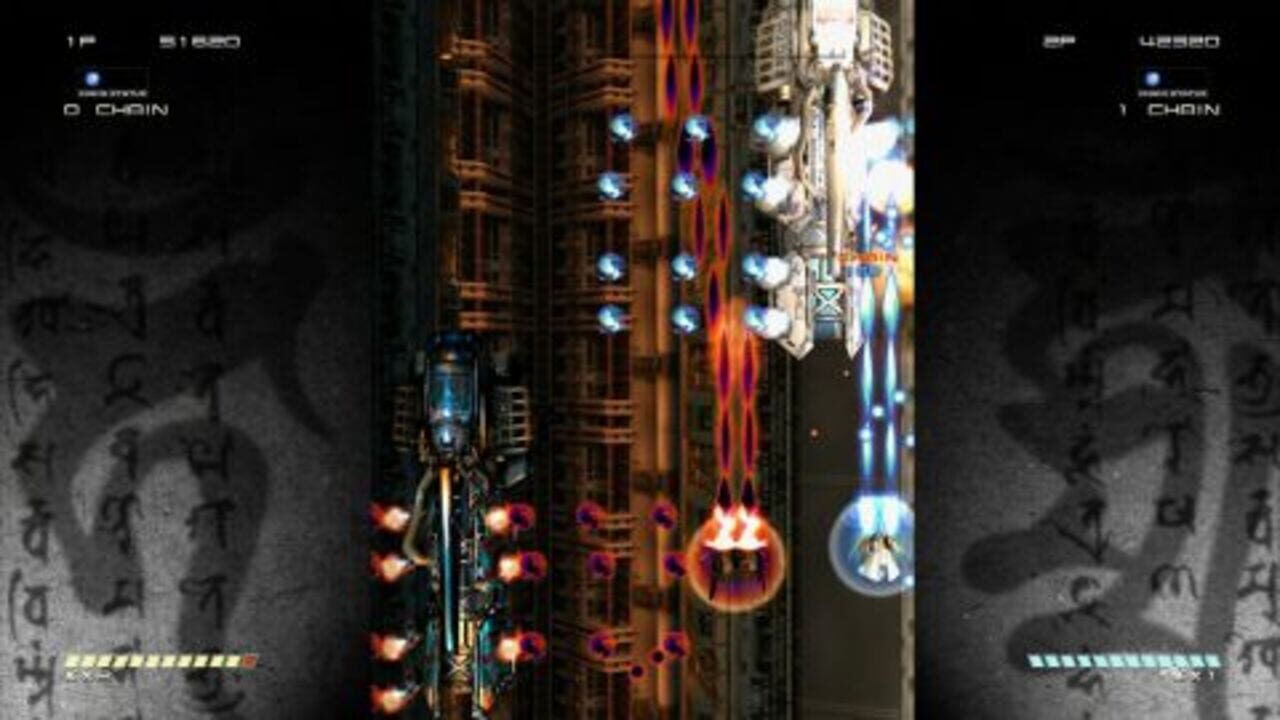
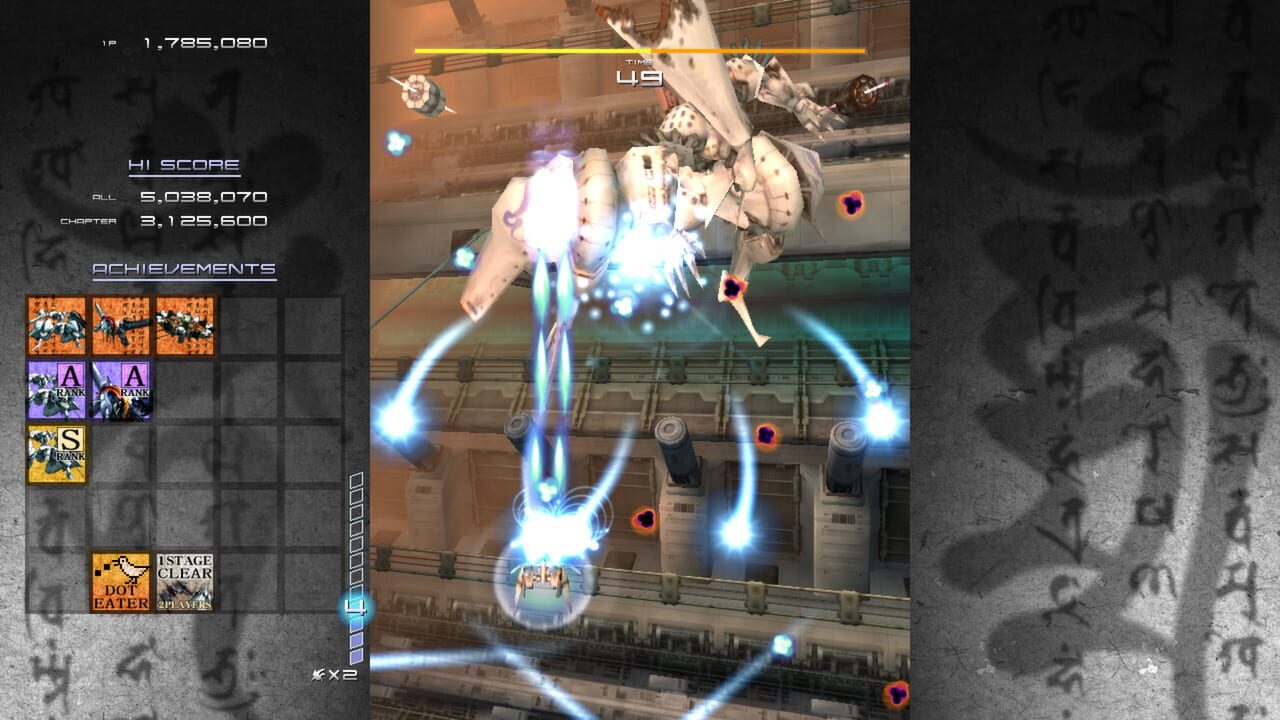
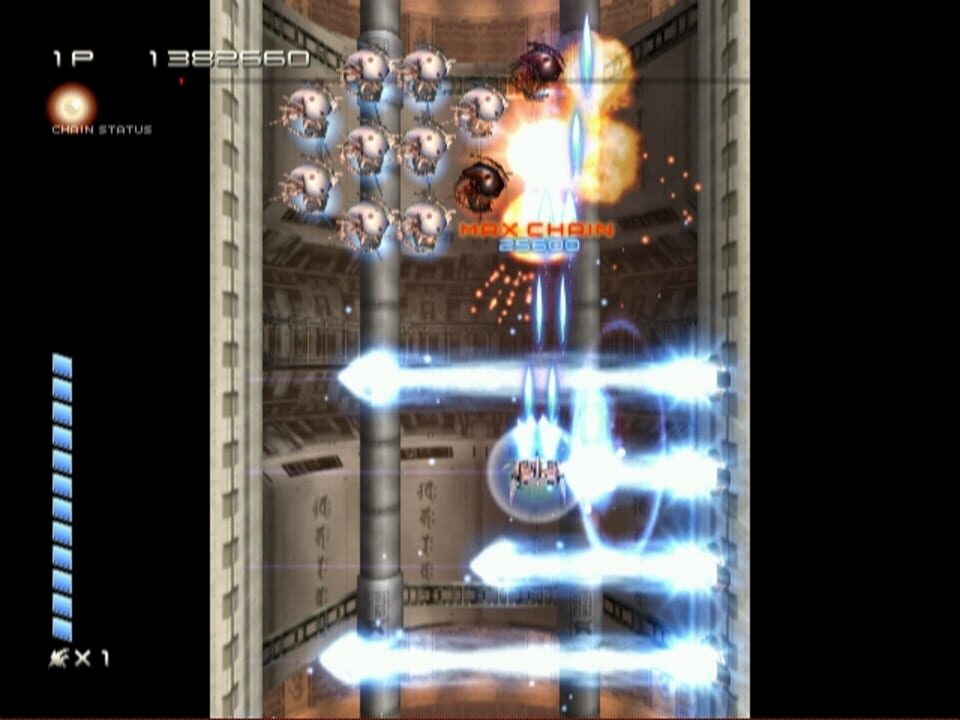
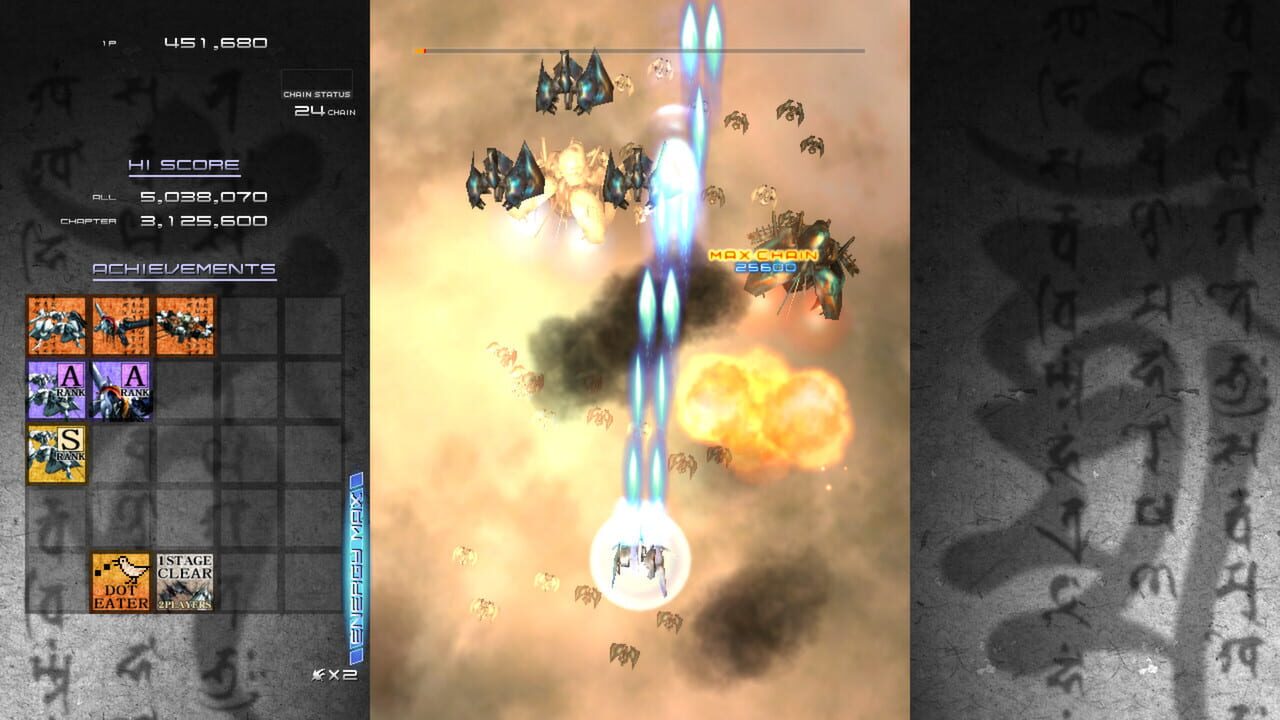
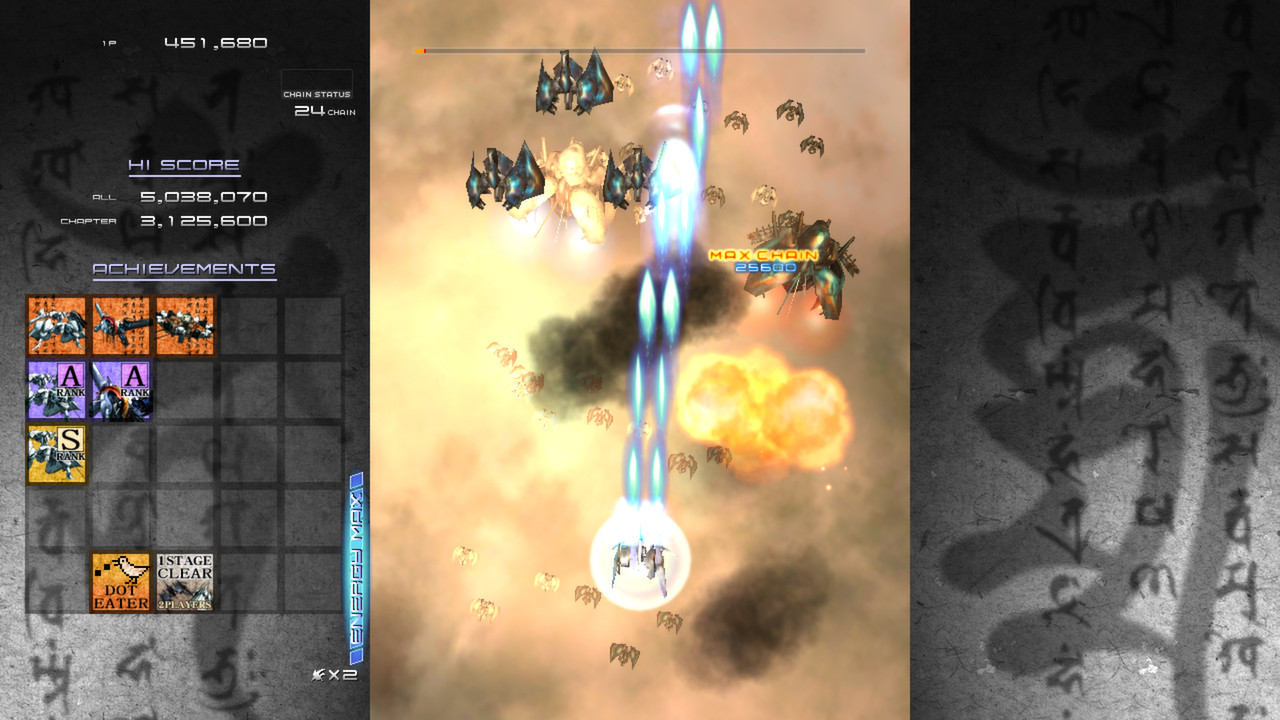
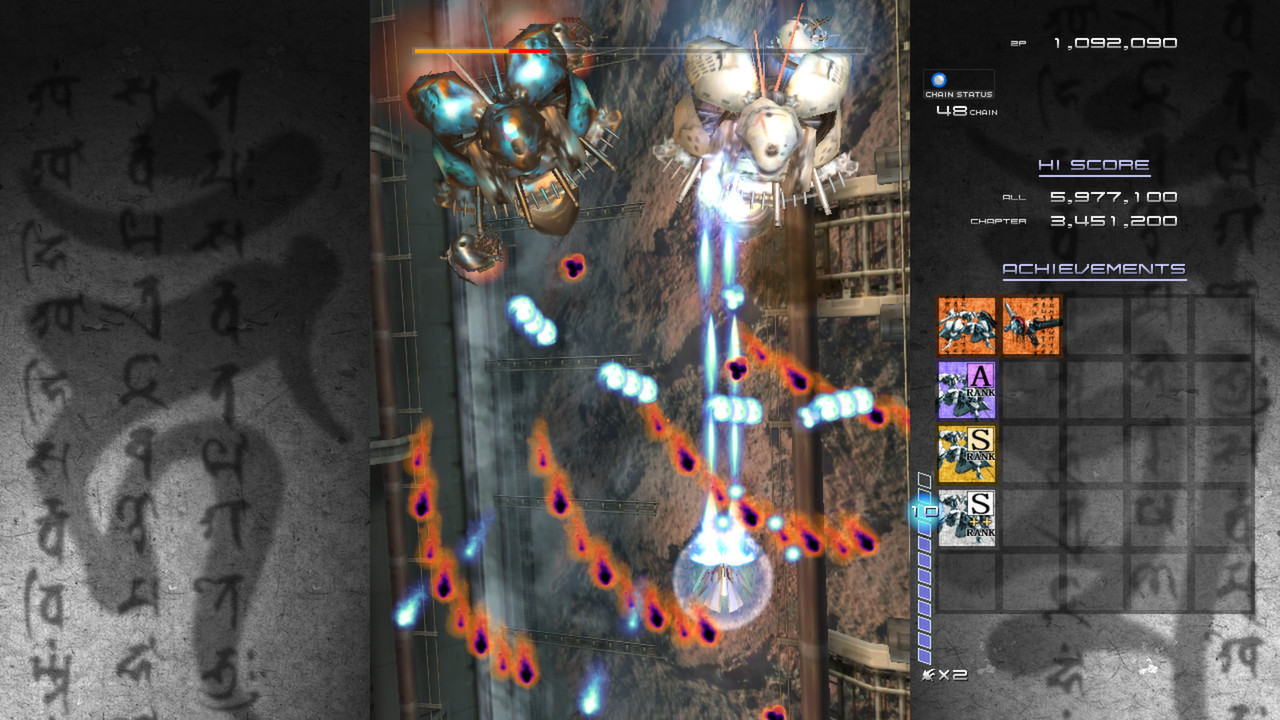
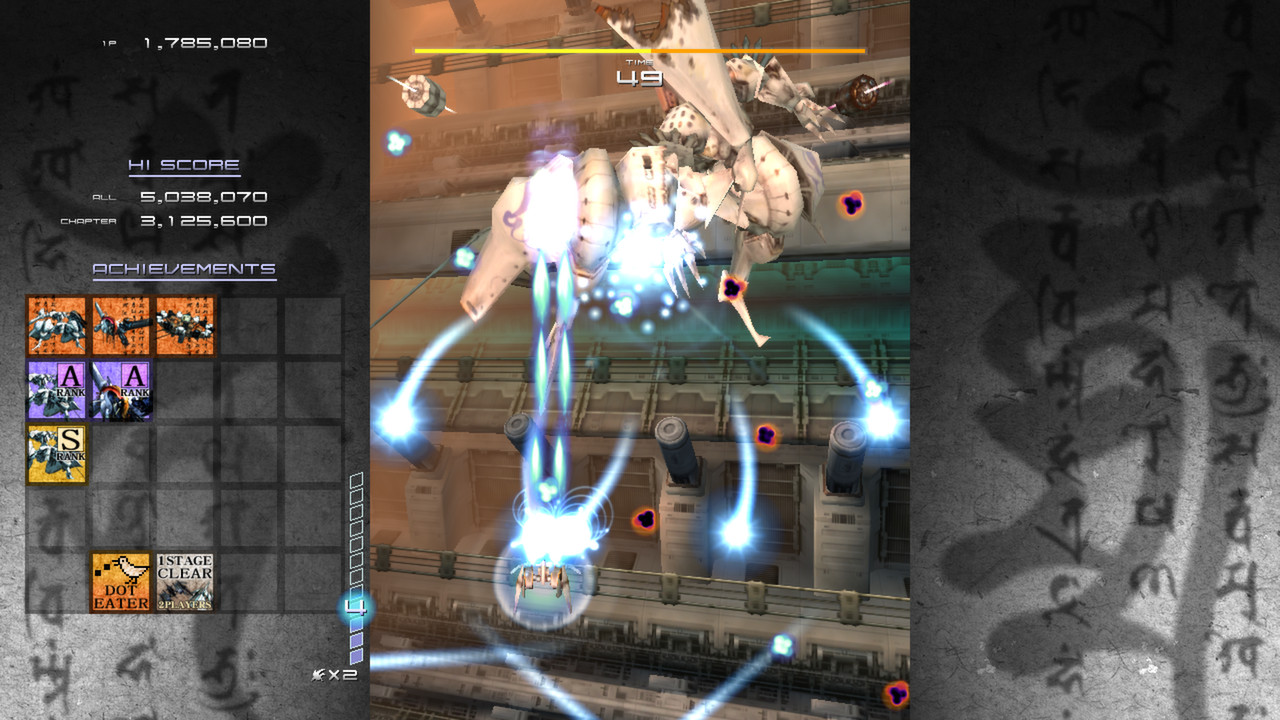
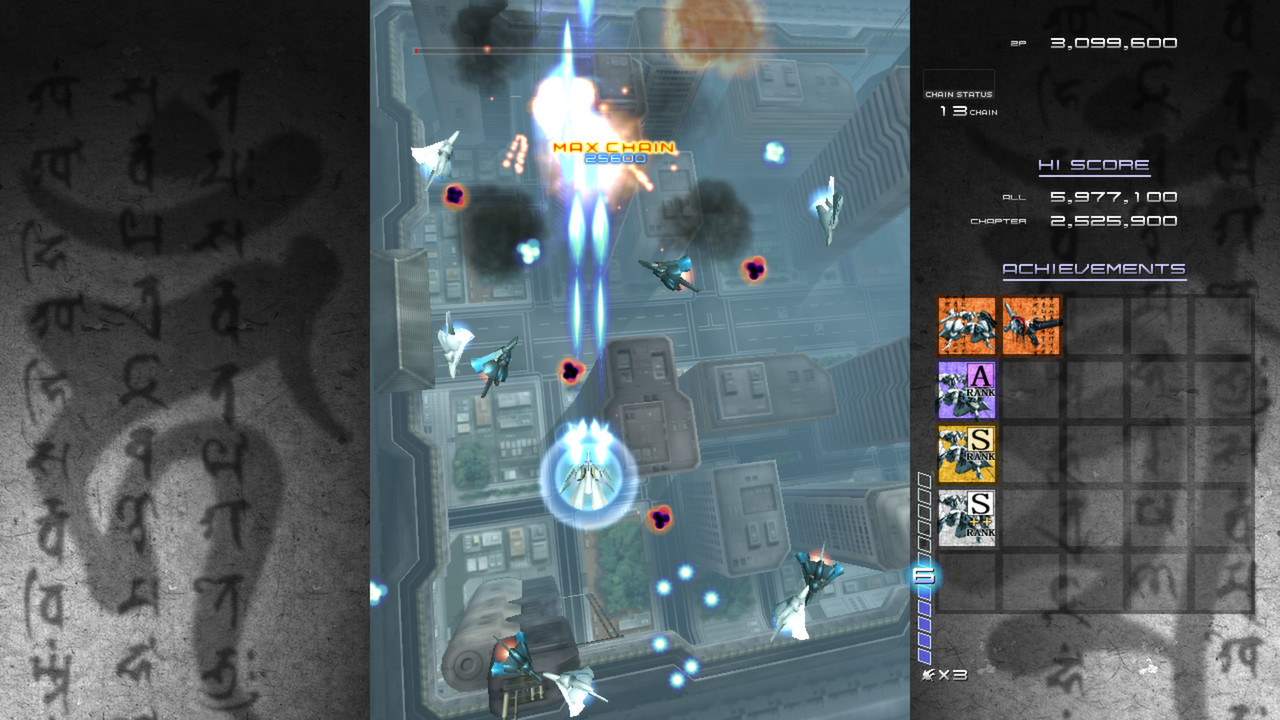
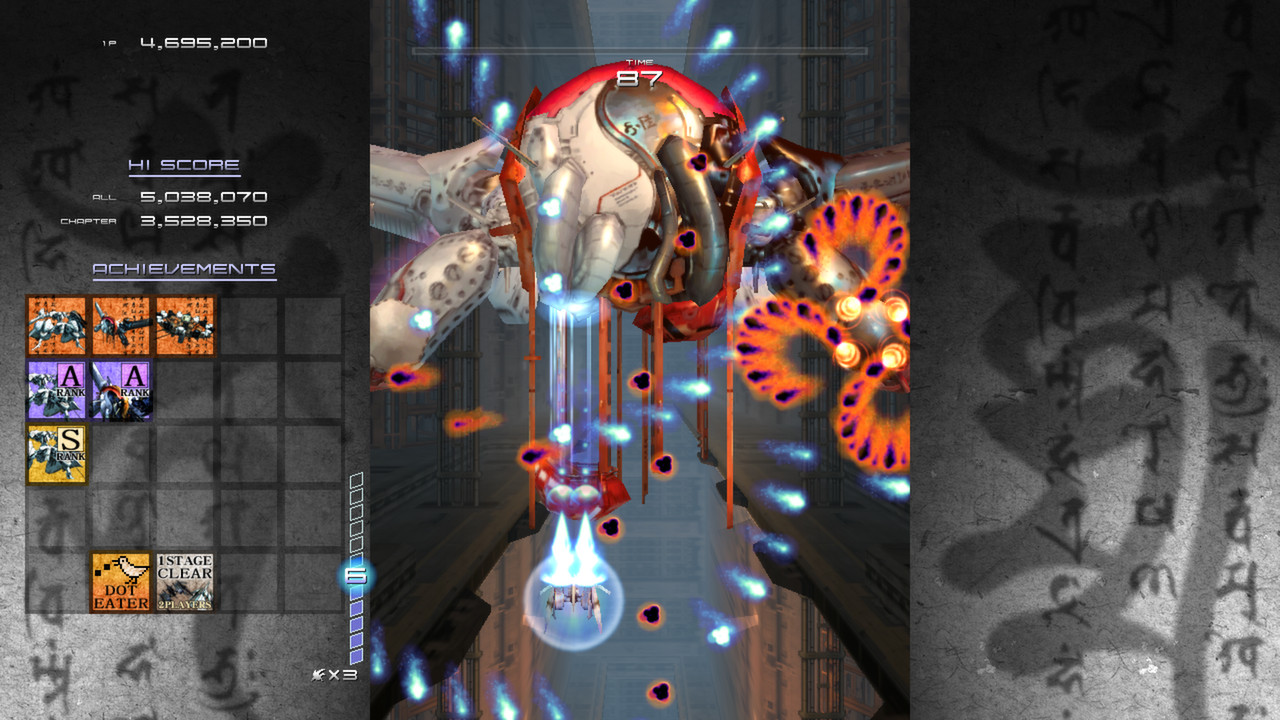
In this vertical scrolling spaceship shooter, you control a ship that can change its polarity at will. As blue/white, the ship can easily destroy red/black enemies, and vice versa. Bullets of your polarity can be collected to fuel your energy gauge, but those opposite will kill you. Destroying an enemy ship causes them to fire revenge bullets which can be absorbed and fired back by the player. Different difficulties exist to change exactly how you interact with polarized points, or how they appear. It is the spiritual successor to Radiant Silvergun, featuring similar level and boss design, as well as it's buddhism inspired themes and aesthetics. Both are directed by Hiroshi Iuchi, who also composed Ikaruga's soundtrack.
Description en cours d'enrichissement.
Médias


Informations Steam
Description Steam (Français)
Ikaruga is a vertical shoot 'em up that features an unique polarity-switching gameplay.
Switch the ship's polarity and "get hit and absorb" enemy bullets!
Achieve High Score with the chain bonus!
Features
- The player ship, all enemies and bullets are black or white.
Player's polarity can be switched at will. - Your ship can absorb enemy bullets of the same polarity.
Filled energy goes to fire powerful homing lasers! (Release Power) - Defeat 3 enemies in a row of the same polarity and get the chain bonus!
Building up high scores feels like a puzzle game? - Spectacular 3D graphics. Fast and smooth game play.
- 2 Players game (Local) and
Double Play Mode: You can play 2 Players game with one controller. - 5 levels. Tactical level design and boss battles.
- 3 difficulty levels: EASY, NORMAL, HARD.
Change your tactics depending on the difficulty. - 2 Game modes: ARCADE, PROTOTYPE (not hidden).
- Replay data save is available.
You can also download them from the Leaderboards. - Vertical screen mode support.
You can also play the game like a side-scrolling shooter by rotating only the game screen. - Xbox360 controller, Keyboard and Mouse support.
Éditions et prix Steam
Avis des joueurs Steam
C'est un jeu très fun et challengeant mais malheureusement trop peu connu du grand public
Un peu déconcertant de ne pas pouvoir shooter sur le clavier mais jeu japonais dans la norme de qualité des shoot' em up.
Mises à jour et Actualités
How Steam brought shmups out of arcades and into a new PC renaissance
By the late ‘90s, with Street Fighter 2’s impact on arcades receding in the West, the beautiful rows of wooden cabinets and the glow of their CRTs suffered a commercial deforestation. With their dwindling ranks went the heyday for genres built around a quick play and immediate gratification. Genres like the shoot-em-up, which predates all the rest with links back to 1962’s pioneering Spacewar!In its prime, the shoot-em-up genre swelled with a distinctly Japanese form of game design, screens covered by hellish bullet patterns and anime girls—plus notable domestic off-shoots. Post-arcade, the shoot-em-up, the shooter, the shmup, or the STG (pick your acronym preference) receded into an enthusiast bubble, hidden from view after first and third-person action games captured the designation of 'shooter.'In those dark years, shmup enthusiasts either contended with pricey, obscure late releases on the Dreamcast and Neo Geo, or by sheer will, discovered alternate venues, corners of the internet where potential classics like the enemy pile-on Cho Ren Sha resided prior to common digital distribution and Steam."I found an online resource of Japanese people, just basement devs, who would be posting shmups and posting updates every day online. Some of them were crap. Some of them were unbelievably cool," remembered Don Thacker, founder of Imagos Softworks, developers of the Kickstarted genre cross-over Starr Mazer. Discovery comes easy when wandering a hall of video games, each churning attract screens. Without arcades, those random hubs found by curious Google hunters such as Thacker were it for the shmup’s exposure, outside of certain studios aiming at the die-hard audience. The genre, and with it the shmup’s myriad of sci-fi, fantasy, and military fetishism, fell into disrepair. The mainstream gaming public chewed on ever increasing polygon counts; the dedicated shmup fan sifted through what amounted to back alley digital dumpsters seeking anything of merit still made with scrappy 2D sprites, subwoofer crushing explosions, and mountainous end level bosses.Then, a visible indie game movement, and more so, Steam. Consider the timing as the calendar turned to the 2010s: Kids who mastered joystick controls in front of CRTs burning phosphors, expertly navigating games at the height of shmup popularity—from Namco’s ageless Galaga to Capcom’s beautifully exaggerated, WWII "inspired" 194X series—plug into their nostalgia as developers. Thus a flurry of Steam activity, sizable enough to wear down even the hardened genre devotees, but also a sign of regeneration and visibility. Now developers like Mommy’s Best Games, developer of the neon obsessed heavy metal shmup Shoot 1UP, can find a home for their uniquely textured throwbacks."Steam has been great to release Shoot 1UP to, as it was very successful on Xbox 360 and now we can reach even more people. I love consoles but not everyone has one. With PCs, nearly every gamer has a machine that can run our 1990s style shooters," said Nathan Fouts of Mommy’s Best Games.It’s a gold rush on Steam compared to the genre’s low point. The service afforded a substantial kick to the shmup, which at the turn of the decade saw a fleet of indies in such numbers, Don Thacker amusingly stated that for developers, "Steam is bullet hell." The slow resurgence Throughout the early 2000s, a few notable studios entered the space, some earning wide acclaim, including Treasure’s polarity swapping Ikaruga (no article on shmups is free from Ikaruga’s notable grasp). Aside from Treasure, popular Japanese developer Psikyo (notable for their raucous Strikers 1945 and the perky, daydream-like Gunbird) died off by 2003, vacating the space. Enter Japanese developer Cave.Founded in 1994 but finding their footing as Psikyo neared shutdown, Cave’s numerous early entries include tongue twisting titles DoDonPachi, Espagaluda, and Guwange, the latter boasting a genre-exotic medieval Japan setting. Further efforts in the later 2000s brought on bullets in droves from Mushihimesama, Espagaluda II, and Deathsmiles, the latter fitted with anime witches and anime fantasy and anime tropes to saturated extremes. Each of Cave’s entries fell into a contemporary sub-genre affectionately coined 'bullet hell,' partly unsurprising since the studio’s formation is owed to former employees of the bankrupt Toaplan, arguably where the designation came from following Toaplan’s sci-fi dazzler Batsugun.Bullet hell came to define the zest of a shmup, balancing an elegant ballet of colored weaponry and a playable protagonist with a single weak point, mere pixels (or even pixel) wide. They’re peak shmup, where pressure-driven, graceful movement meets a handsome (and ceaseless) display of enemy attack patterns. Steam is full of these gripping yet punishing games, including a back library of Cave’s work. "There's a strong support for Cave and the bullet hell genre itself… The shooting game developers catered more to a dwindling audience who were demanding harder and harder games," noted James Wragg, Director of Publishing at Degica, responsible for bringing some of those Cave classics to Steam."Steam fills that gap and enables companies. They don't need to go through a publisher like us. They can publish independently," began Wragg. "It basically allows them to publish without all of the red tape of the platforms like PlayStation, Xbox, Nintendo. In theory, it opens it up to a much wider audience because Steam's got such a huge user base.""It's very encouraging to see a lot of indie circles start to release stuff on Steam. Back in my day, you wouldn't see that. But now you're seeing stuff like Crimzon Clover Mecha Ritz ," said Danny 'danbo' Baxter of Stellar Circle, developer of 2016’s Blue Revolver, a suitably low-fi gem owing much to Cave’s turn-of-the-century design philosophy. Influenced Nostalgic influence feeds the listings on Steam, cultivating a collection of shmups which hit every classification in a varied genre—vertical, horizontal, traditional, even twin stick (although the hardcore community may find the inclusion dubious). Shmups even interject themselves elsewhere."If you click the bullet hell tab on Steam, you'll see a lot of games that bear no resemblance to something that I've been playing. Undertale had bullet patterns, Neir Automata is going to have them," said danbo a few weeks before Nier's release.The rush of games—and those borrowing elements—has caused a touch of in-fighting between those passionate for the striking difficulty of bullet hell and those seeking something more passive. Like Degica’s Dariusburst, the continuation of a decades old franchise set in deep space as players set ablaze robotic, oceanic inspired creatures. In a genre of familiar routines, Darius is (and forgive the pun) in a sea of its own."There's a certain generation where their first encounter with shooting games was bullet hell. For them, bullet hell equals shooting games. We came across this when we released Dariusburst. Some of the reviews from users saying there's not enough bullets on screen, but it's like comparing Virtua Fighter to Street Fighter," said Wragg, noting the wide separation in shmup styles. Steaming Paging the community on hangout Shmupsforum, users expressed dismay surrounding imperfect ports, brought up fandom punching bag Sine Mora for a laugh, and tossed positive sentiments at the modern accessibility of the genre. "The recent deluge of shmups on Steam has been a great thing… The genre is finding a wider audience and there have been some great indie efforts. Shmups are alive and kicking and I hope it continues forever," noted one user. "At the same time, especially in recent years, it also allows for a boatload of shovelware to gum up the works," countered one forum regular.As with Steam in general, the visibility problem grows with each new game added to the service. "I think Steam is brilliant at making things accessible. I also think Steam added more games last year than Steam had previous," stated Thacker. "If you look at our little pie slice on Steam and you fill it 80% with Cave games, I think it's going to be hard for us to have the discussion about a genre a lot of indies are trying to put back together."Wragg, however, welcomed the influx. "I'm happy to see competition in the market because competition is good for everybody. It makes people push harder and I'd rather see the shooting genre go somewhere other than just bullet hell and have somebody come up with crazy mechanics that push things in other directions. The only way that can happen is through new people with new ideas coming in." I'd rather see the shooting genre go somewhere other than just bullet hell and have somebody come up with crazy mechanics that push things in other directions.James Wragg Bullet hell continues to dominate on Steam. Of the 15 pages of games listing themselves under shoot-em-up, nearly half pin themselves to bullet hell. "There's definitely a lot of games you could play, but I'm not sure how many of those are really geared to getting people into games like bullet hell," said danbo. "For the beginner coming in, it is a very difficult place to start. But Steam again on that front allows people to, without much of a financial investment, pick up couple of shooting games in the sale or a couple of really well priced indies," said Wragg.Games like Thacker’s gorgeous Starr Mazer, mixing horizontal shooting and point-and-click gameplay, come pre-designed for entry level play. "I've had 45, 50 year old guys come up and they'll be like, 'Oh, it's Galaga.' It's super not, but I understand that's all you can link it to so let's use that as a stepping stone." Those looking to jump in on Steam might be turned away by Cave’s kinetic, even exuberant style, but can find solace elsewhere. " pretty simple to pick up. You can sit around with two, three, four players locally, enjoy it with your friends and the mechanics work very well for multiple players," said Wragg. He’s right: Jamestown’s friendly H.G. Wells-meets-American-Western aesthetic marries to a charming entry level pixel adventure without being first baptized by Cave.If nothing else, the genre remains alive, and in good hands. The indie surge brought on by Steam, for its inevitable faults in saturation, allows developers to find a home. “If you haven't gone to the shmup section on Steam, check out some indies. You're missing a lot," began Thacker. "Also if you grew up in the ‘80s and ‘90s and you liked shmups, they're there. They exist. It didn't go away with arcades. They survived."And Steam certainly helped.
Ikaruga's rule of threes
WHY I LOVEIn Why I Love, PC Gamer writers pick an aspect of PC gaming that they love and write about why it's brilliant. Today, Tom digs deeper into the atonishing Ikaruga.Ikaruga is an arcade shmup that arrived on PC last year. It's famous for both its difficulty and its central conceit: your light shield absorbs light bullets; your dark shield absorbs dark bullets. When you switch polarity, your bullets switch too, dealing double damage to enemies of the opposite affinity. Ikaruga wrings increasingly complex challenges out of this simple idea. It traps you, blasts you with beams wider than your vessel, and pins you down in shifting fields of laser fire. One moment it's a duck-shoot, the next a puzzle, and then a maze, then a bossfight. By the end of Ikaruga's 25 minute span it has spun the polarity system into hundreds of challenges that flow into one another every ten seconds or so. It's a case study in how to extrapolate a single mechanic into an entire game. But there's more to Ikaruga than that. Half of the game is about survival, and half is about your score, and the sought-after S++ rank. To score big you must assemble chains by shooting enemies in clusters of three: three dark enemies, three light, another three light, three dark—the order doesn't matter. Keep killing in triplets; don't break the chain. This discovery changed my entire perception of Ikaruga. There was an order to the world that had been staring me in the face for hours, and I'd blindly ignored it. Enemy hordes suddenly had purpose. This wasn't a chaotic storm of enemies, but a beautifully constructed pattern of opportunity. Every clustered trio of enemies is a little gift from the designers. My fully powered up homing missile barrage fires twelve shots—an easy chain of four if I manage to eliminate dark enemies and leave white intact. The battleships in chapter one have eight broadside turrets, once destroyed the host vessel itself can be popped for a tidy triple-chain. The spare blocks in chapter one's block maze suddenly have a reason to exist—to think I'd left them unharmed for so long. Most of the routes I'd learned so far helped me stay alive, but proved completely inefficient for chaining. I had to learn new behaviour and achieve a new level of finesse. I could no longer attack the level with a relentless stream of bullets. Some sections need a sniper, so I learned to weave into a pack of enemies and zap them with single shots, like dotting the i s on a dense, moving manuscript. I came to realise that I am not good enough at games to do this. As you plunge in to chapters three and four, the bosses grow tougher and the enemies faster. I studied videos of Ikaruga masters, and saw a gulf in skill that was well beyond me. It was an education, however, in how an extra layer of challenge can have a powerful transformative effect on a game. Treasure managed to achieve that within the confines of an incredibly simple set of rules. I can only marvel at their skill. Now, if you don't mind level design spoilers (Ikaruga has little discernible story), here's a full run of the game, completed by someone who is stupidly good at the game.
Updated (Build 354142)
Added 'APPENDIX' menu. Gallery and SoundTracks mode. Change title screen pictures to HD Chapter 1: Fixed slowdown of the scene after the chapter title. (Change far objects to billboard, and speed up) Fixed minor bugs アップデートしました(ビルド ID 354142) おまけメニュー(APPENDIX)追加。ギャラリー、サウンドモード。 タイトル画面を高解像度化、調整 Chapter 1 雲海上のシーンの高速化 他、バグ修正など
Avis des critiques et joueurs
Critiques de la Presse (Metacritic)
« Treasure has crafted another masterpiece of hyper-tuned overhead shooter action, the likes of which the world may never see again. [Apr 2003, p.57] »
« Ikaruga owns you. It's hard as heck, but it's also a pleasure to play and watch. Don't wuss out; play it. [May 2003, p.41] »
« While the game obviously plays like a 2D shooter, the backgrounds are 3D rendered and the game just combines the technology of today with the old-school gameplay perfectly. »
« Once I reached that Zen state of immersion, it felt as though the controller and I were one entity, working together to achieve a common goal. As I wove through a barrage of bullets, deftly changing colors in order to survive, I knew that Treasure had crafted a jewel. »
« If you love shoot'em ups, or even just love great games, go out and buy Ikaruga now. »
« Games like this simply aren't made very often, especially not of this caliber. It has incredible depth for a shooter, replay value through the roof, and most importantly, it's fun to play. [JPN Import] »
« Addicting, beautiful, and challenging; everything anyone could ask for in a video game. »
« Ikaruga is the finest shooter I have ever played. From Space Invaders to Xevious all the way to the games spiritual predecessor Radiant Silvergun, Ikaruga is the epitome of the vertical shooter. »
Avis des Joueurs (Metacritic)
« gran joya de la GC,corre fantástico.. un video juego complejo, un Shootemup puzzle inolvidable. »
« This is a fine rail shooter. Not a fan of the narrow screen, but it’s challenging and would be a lot of fun as a local co-op. »
« Si bien no llega a la excelencia de Radiant silvergun, Ikaruga es uno de los mejores matamarcianos de la historia. La dualidad entre blanco y negro es la esencia del juego y es sencillamente espectacular. La única pega es que es muy corto. »
« A really hard but an amazing bullet hell shoot 'em up that Treasure is always great at making them. Easily recommend it to those who love shoot 'em up games or games that are made by Treasure like Gunstar Heroes and Radiant Silvergun as well. »